What is an agentic security operations platform?

Security leaders are facing a generational platform decision. Before evaluating vendors, it's important to understand what the agentic model actually requires.

  • 85%

    Of security analysts describe their work as painful. This isn't an HR problem. It's a breach risk — and it's structural.

  • $322B

    Agentic AI security market by 2033. Up from $7.8B today. 34% CAGR — the fastest-growing segment in enterprise security.

Definition

Agentic security operations platform, defined

An agentic security operations platform is a unified system in which human analysts retain final judgement, approval authority, and strategic direction while autonomous AI agents handle the full security lifecycle — from data ingestion and alert correlation through threat investigation and response execution.

  • Not a fully autonomous SOC

    The agentic security operations platform is not a fully autonomous SOC. The human is not removed from the loop — they are moved to the top of it. The platform investigates, correlates, and builds the response plan. The analyst reads it, judges it, and approves it.

  • Not a separate SOAR with an AI layer

    Legacy SOAR tools execute deterministic playbooks. Agentic platforms reason through novel situations dynamically — they are architecturally different, not incrementally better.

  • Not a next-generation SIEM

    A SIEM ingests and correlates. An agentic platform ingests, reasons, investigates, builds a case, proposes a response, and executes it — in one unified system.

Why now?

The threat environment changed. The SOC model hasn't.

Security architectures were built for a world where threats moved at human speed. That world is gone. The convergence of adversarial AI, analyst burnout, and architectural fragmentation has created a structural crisis in security operations.

  • 4.5x

    Higher click-through rate of AI-generated phishing versus traditional methods. Social engineering is now industrialized at scale.

    Source: Microsoft Digital Defense Report, 2025

  • 74%

    Of breaches involve alerts that were generated but ignored — not because analysts weren't paying attention, but because the noise-to-signal ratio made processing impossible.

    Source: Verizon DBIR

  • <2 years

    Average analyst tenure before burnout-driven attrition. The talent crisis is not a pipeline problem — it is a tooling problem.

    Source: Tines/Abnormal AI Research

  • 11

    Average number of security consoles an analyst navigates per investigation. Each pivot is time the adversary is already using.

    Source: Microsoft/Omdia State of SOC

The structural shift

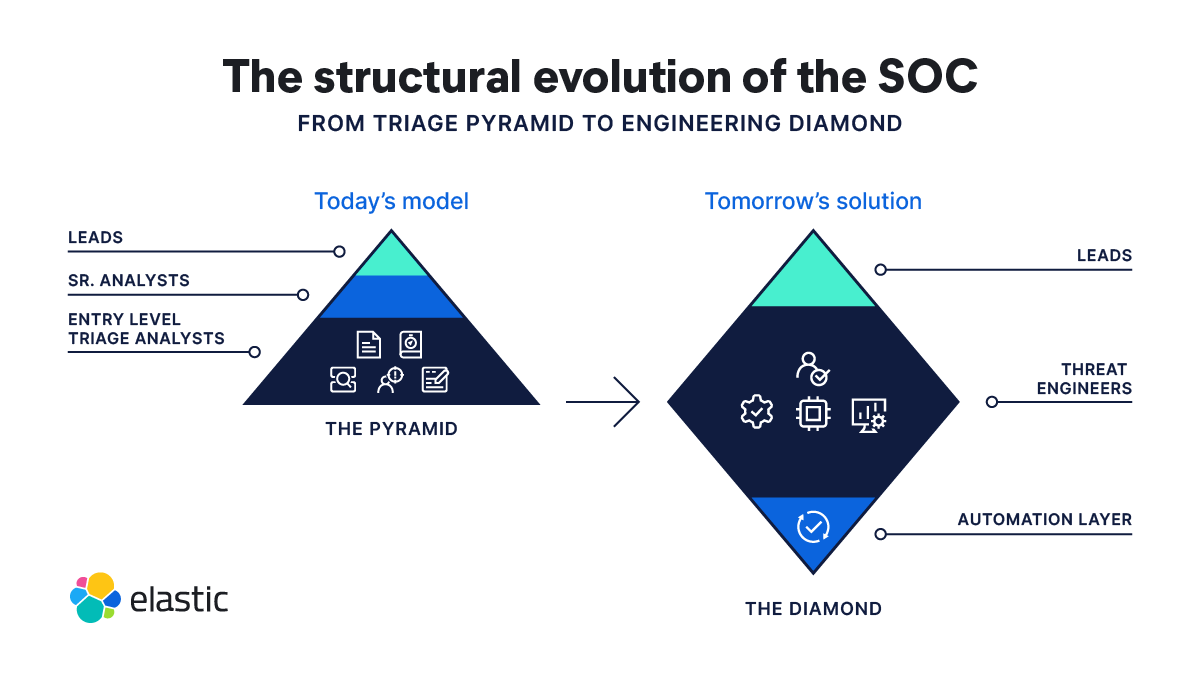
From triage pyramid to engineering diamond

As agents handle routine triage and enrichment, analysts move up — becoming threat engineers who direct strategy, tune agents, and focus on the threats that require human judgment.

The SOC gets faster, more accurate, and harder to breach.
What an agentic platform requires
  • Ingestion at scale

    Perceive everything, miss nothing

    An agentic platform can only reason over data it can see. Coverage gaps — whether forced by per-device pricing or rigid data pipelines — become attack surface. AI-driven threats are engineered to find unmonitored assets.

  • REASONING WITH SPEED

    AI grounded in your data, transparent by design

    The reasoning layer is where agentic platforms differ most from legacy tools. AI decisions must be grounded in your actual security data — not a connector abstraction — and transparent enough that analysts can validate every conclusion.

  • Prevention and response

    From detection to containment at machine speed

    Prevention is the fastest possible response. But when an active incident requires containment, the response must execute faster than a human queue can process. Human judgment stays at the center — every action is approved before it executes.

Comparison

Agentic SOC vs. legacy architecture

The legacy model was not built for this moment. See how an agentic platform compares across the dimensions that matter most to a security leader evaluating direction.

Legacy SIEM
Next-gen XDR
Agentic SOC platform
Incident response speed
Hours — manual triage and escalation
Minutes — automated playbooks
✓ Seconds to minutes — agentic reasoning + human approval
Handling novel attacks
✕ Playbooks require premapping
~ Rules-based, limited adaptability
✓ Agent reasons through unseen attack patterns
Data coverage model
✕ Pricing may force coverage gaps
~ Endpoint-centric, gaps elsewhere
✓ Universal ingestion, no forced tradeoffs
AI transparency
✕ Black-box vendor AI (if any)
~ Proprietary models, limited auditability
✓ Full prompt visibility, model choice, auditable
Human role
In the loop — reviews every alert
In the loop — reviews escalations
On the loop — judgment and final approval
Tool consolidation
✕ SIEM + SOAR + XDR separate
~ Endpoint + cloud, SOAR still separate
✓ Detection, investigation, and response in one platform
Historical data at incident time
✕ Rehydration delays
✕ Limited lookback
✓ Years queryable in real time
Deployment flexibility
~ Mostly cloud-dependent
~ Mostly cloud-native
✓ Cloud, on-prem, air-gapped — model sovereignty
Incident response speed
Handling novel attacks
Data coverage model
AI transparency
Human role
Tool consolidation
Historical data at incident time
Deployment flexibility
Legacy SIEM
Next-gen XDR
Agentic SOC platform
Hours — manual triage and escalation
Minutes — automated playbooks
✓ Seconds to minutes — agentic reasoning + human approval
✕ Playbooks require premapping
~ Rules-based, limited adaptability
✓ Agent reasons through unseen attack patterns
✕ Pricing may force coverage gaps
~ Endpoint-centric, gaps elsewhere
✓ Universal ingestion, no forced tradeoffs
✕ Black-box vendor AI (if any)
~ Proprietary models, limited auditability
✓ Full prompt visibility, model choice, auditable
In the loop — reviews every alert
In the loop — reviews escalations
On the loop — judgment and final approval
✕ SIEM + SOAR + XDR separate
~ Endpoint + cloud, SOAR still separate
✓ Detection, investigation, and response in one platform
✕ Rehydration delays
✕ Limited lookback
✓ Years queryable in real time
~ Mostly cloud-dependent
~ Mostly cloud-native
✓ Cloud, on-prem, air-gapped — model sovereignty

Evaluation guide

Questions to ask before you commit to a platform

Not every platform claiming the agentic label was built for it. These questions help security leaders separate architectural reality from marketing positioning.

  • Critical

    Does the platform reason adaptively or execute prescripted playbooks?

    Deterministic automation breaks when attackers deviate from expected patterns. An agentic platform uses skills invoked dynamically by an agent reasoning through each incident — including attacks it has never encountered before.

  • Critical

    Can analysts see and validate every AI decision?

    Transparent AI — visible prompts, auditable reasoning, verifiable outputs — is not optional. If your AI cannot show its work, your analysts cannot trust its conclusions. Unauditable AI decisions are an emerging compliance liability.

  • Important

    Is automation native to the platform or a separate integration layer?

    A stand-alone SOAR creates an integration point that fails during active incidents — exactly when response speed matters most. Native automation in the same system as detection eliminates this structural failure mode.

  • Important

    Can historical data be queried in real time during an active incident?

    Rehydration delays that make historical logs unavailable for hours are a structural vulnerability during active campaigns. An agentic platform requires years of telemetry accessible at query time with no penalty for looking back.

  • Strategic

    Does the platform support model sovereignty and deployment flexibility?

    Regulated organizations — particularly government and financial services — require the ability to choose their AI model, including fully disconnected on-premises models. Vendor lock-in to a single LLM is incompatible with data residency and sovereignty requirements.

Frequently asked questions

Get answers to questions security leaders commonly ask when evaluating the agentic security operations model.

How is an agentic SOC different from a traditional SOC?

A traditional SOC relies on a pyramid of analysts manually triaging alerts and escalating to senior staff. An agentic SOC replaces the base of that pyramid with an automation layer. AI agents handle triage, enrichment, correlation, and initial investigation. Human analysts operate as threat engineers — directing strategy, approving responses, and focusing on the threats that require human judgment.